by
by
In this tutorial, we explain how to derive a transfer function of a low-pass active filter that is created using an operational amplifier. The YouTube video is given below.
The amplifier circuit is shown in the figure below. It consists of an ideal operational amplifier, two resistors with the resistances  and
and  and the capacitor with the capacitance of
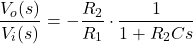
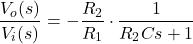
  . Our goal is to show that the transfer function of this circuit is
(1) 
where  and
and  are the Laplace transforms of the output and input voltages
  and
and  .
.
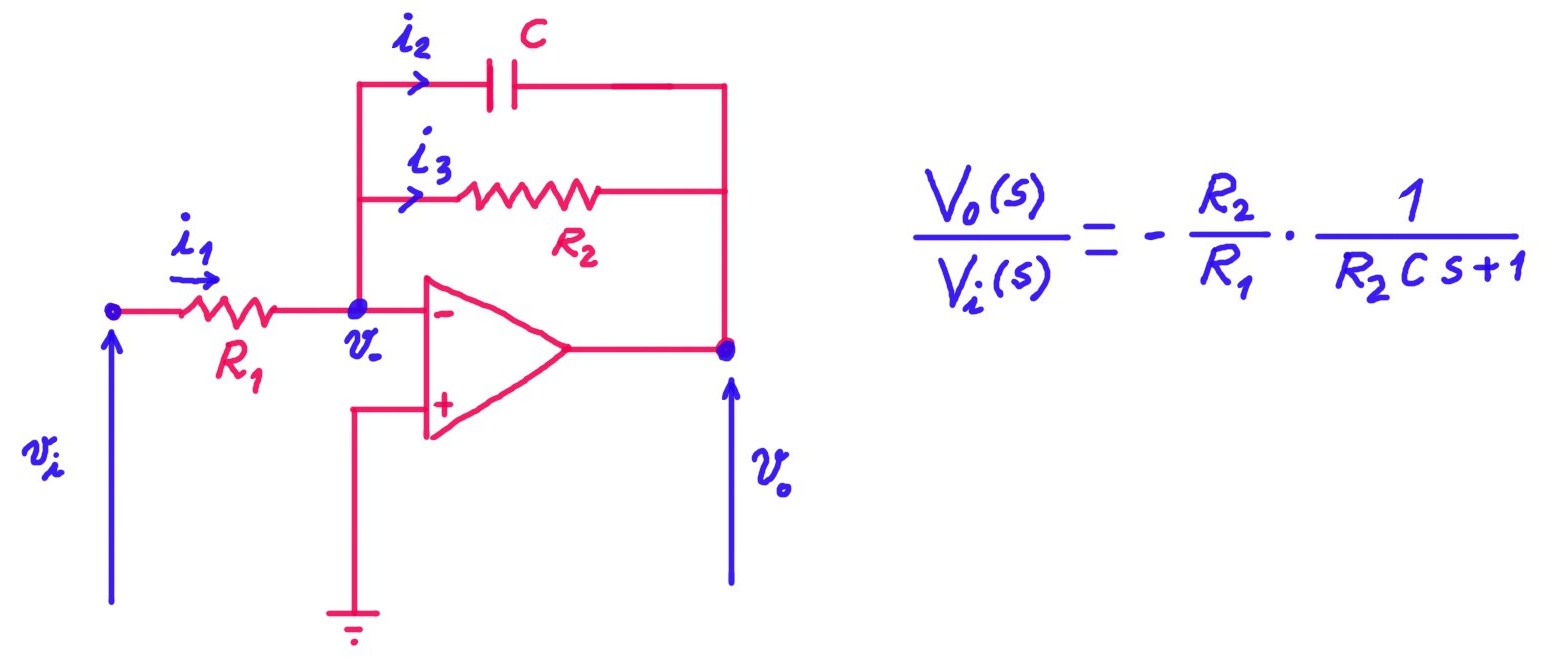
From the figure above, we have that the currents are given by the following equations:
(2) 
Taking into account that  , we can simplify the equations given above
(3) 
On the other hand, we have
(4) 
By substituting (3) in (4), we obtain
(5) 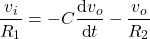
The last equation can be written as follows
(6) 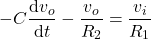
This equation is an ordinary differential equation describing the dynamics of the circuit. By applying the Laplace transform to this equation while neglecting the initial conditions, we obtain
(7) 
From the last equation, we obtain the transfer function of the low-pass active filter using the operational amplifier
(8)