In this tutorial, we explain how to derive a transfer function of electrical circuits using impedances. As an example, we use an RLC (resistor, inductor, and capacitor) circuit. The YouTube tutorial is given below.

Problem Formulation
Consider the circuit shown below consisting of the capacitor with capacitance 


Derivation of the transfer function using impedance approach
To solve this problem, we use the impedance approach. The idea is to convert this circuit in the complex s-domain and use impedances. The impedances are explained in our previous tutorial given here. The circuit in the s-domain is shown below.


In the figure above, 


(1) 

In the figure above, 


(2) 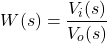

To derive this transfer function, let us first simplify the notation by dropping out the dependencies on the complex s-variable. For example, instead of 

(3) 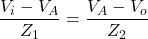

From the last equation, we have
(4) 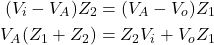

Finally, we get
(5) 

On the other hand, we have
(6) 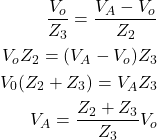

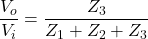
By substituting the last equation in (5), and after several manipulations, we obtain the transfer function that depends on impedances
(7) 
By substituting impedances for the resistor, capacitor, and inductor in the equation (7), we obtain the transfer function expression
(8) 
