In this electrical engineering tutorial we explain how to derive a transfer function of an RC (resistor and capacitor) circuit. The YouTube video is given below.

Problem Formulation
Consider the circuit shown below. The circuit consists of the resistor with the resistance of 


Derivation of the transfer function of the RC circuit
To derive the transfer function, we use the impedance approach. We transform the circuit shown above in the complex 


In the figure above, the impedance 

(1) 

The impedance 
(2) 

The Laplace transform of 


By using the Ohm’s law in the complex Laplace domain, we obtain
(3) 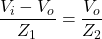

where for notation simplicity, we drop out the dependence of variables on
(4) 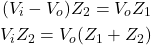

From the last equation, we obtain
(5) 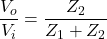

By substituting the impedances in the last equation, we obtain
(6) 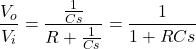

The last equation is the transfer function of the RC circuit. Obviously, this is a low-pass filter. The break frequency or the corner frequency is given at
(7) 
